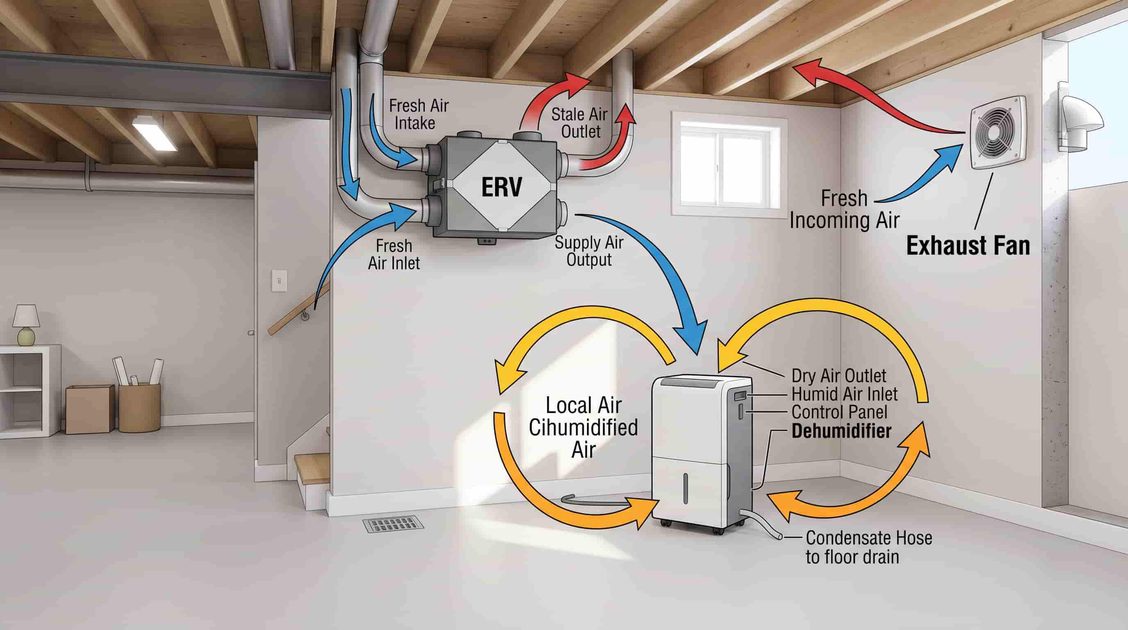
A finished basement that smells like a basement has failed. The drywall is up, the floor is in, the lighting looks great, but the air feels heavy and carries that faint musty note. The problem is almost never moisture alone. It's air that hasn't moved in six months. Basements trap air because warm air rises and there's no stack effect pulling fresh air through a below-grade space. You have to move it mechanically. Three pieces of equipment do that work.
The Three Tools
ERV
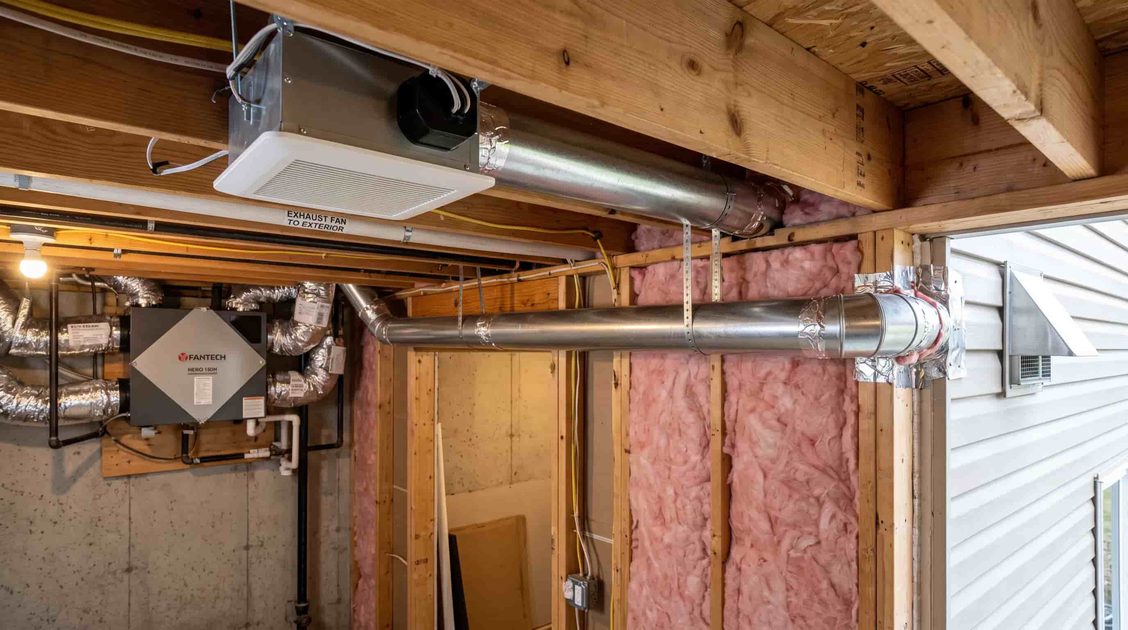
An Energy Recovery Ventilator exchanges stale indoor air for fresh outdoor air while transferring heat and moisture between the two streams. In winter, it pre-warms incoming cold air with outgoing warm air. In summer, it pre-cools and dehumidifies incoming air. It runs continuously at low speed. An ERV is the best solution for a basement ADU or guest suite that needs consistent fresh air year-round. It's also the most expensive: $1,200 to $2,200 for the unit, plus ducting and electrical. I spec ERVs in basement apartments and sealed media rooms with no operable windows. The Hyde Park ADU we covered earlier uses one, tied to a dehumidistat.
Dehumidifier
A standalone dehumidifier pulls moisture out of the air and drains it to a floor drain or condensate pump. It doesn't bring in fresh air. It only controls humidity. I spec a dehumidifier in every finished basement, regardless of other equipment. Set it to 50 percent relative humidity and leave it. Chicago summers will push a basement to 70 percent RH without one, and that's the range where mold grows and dust mites thrive. A unit rated for 50 pints per day handles up to 800 square feet. Cost is $200 to $400.
The One Fan
A small, continuously running exhaust fan — 50 to 80 CFM, vented to the outside — changes more than you'd think. It creates negative pressure that pulls conditioned air from the house above into the basement, then exhausts stale air out. This single fan, running 24 hours a day, keeps air moving through the space. It costs under $150. It uses about as much electricity as an LED bulb. I install one in every basement media room and lounge, tied to a timer or humidistat. It's the cheapest air quality upgrade that makes a noticeable difference. Clients notice within a week: the basement stops smelling like a basement.
How I Combine Them
The Standard Stack
For a dry basement with no moisture history, the stack is simple: dehumidifier plus exhaust fan. The dehumidifier controls humidity. The fan moves air. Total cost: under $600, and a homeowner can install the fan in an afternoon with a hole saw and a dryer vent kit. This covers most Chicago basements used as media rooms, offices, and playrooms.
The Sealed Room Stack
For a basement with no operable windows — or a speakeasy that needs sound isolation — I add an ERV to the stack. The exhaust fan still handles baseline air movement. The ERV brings in fresh air without opening a window. The dehumidifier handles summer humidity spikes. This trio costs $2,000 to $3,500 installed but delivers air quality comparable to above-grade conditioned space.
What Never Works
Opening a basement window a few hours a week. That moves air through one corner and leaves the rest of the basement stagnant. A bathroom exhaust fan on a timer that runs for 20 minutes after a shower. That's for moisture events, not continuous air exchange. A dehumidifier alone without any air movement. That controls humidity but does nothing for CO2 buildup or off-gassing from furnishings.
The Test
If you walk into your finished basement and notice a smell — any smell — the air isn't moving. Install the fan first. It costs less than dinner for four and it might be the only thing you need.




No notes yet — write the first one.