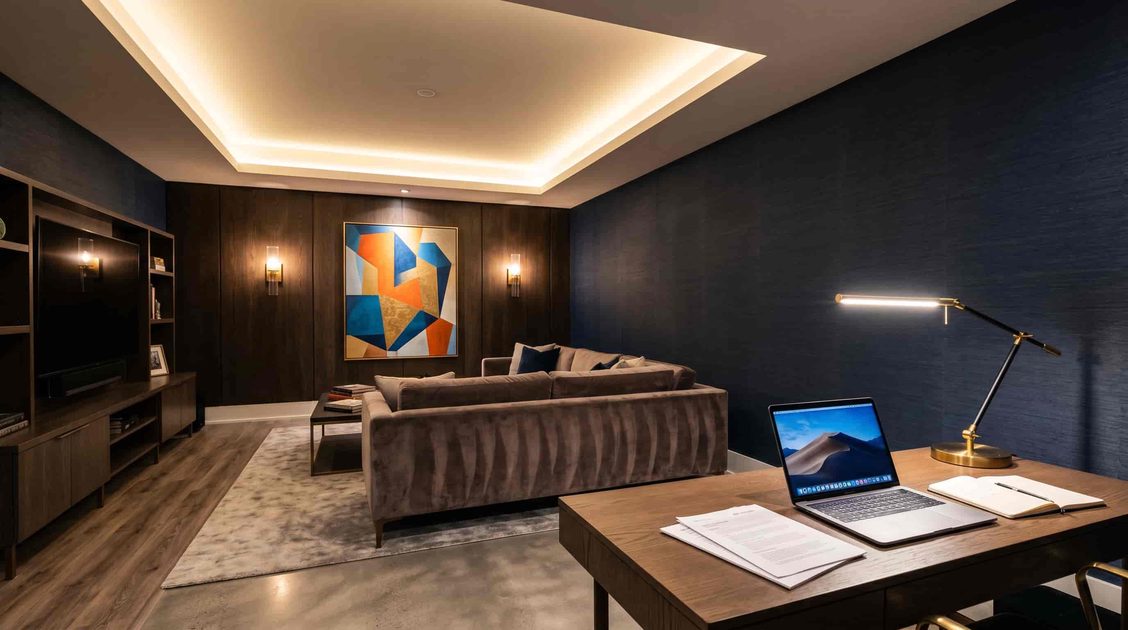
Above grade, a room gets by on a ceiling fixture and a table lamp. Below grade, that formula fails. The ceiling is lower. The walls are concrete or drywall over insulation. There is no window washing the room with ambient daylight. Every photon has to come from a fixture, and every fixture has to work twice as hard. A basement lit by a single overhead light looks like a basement. A basement lit in four layers looks like a room that happens to be underground.
Why Basements Need More
No Free Light
Upstairs, daylight fills shadows. Even on a cloudy day, a room with windows gets diffuse ambient light that softens contrast. A basement starts at zero. Every shadow is deep. Every corner goes dark without deliberate placement. You need more sources because there is no baseline illumination.
Low Ceilings Change Perception
A ceiling at 7 feet 6 inches feels lower if light comes only from above. Overhead downlights create pools of brightness on the floor and leave the ceiling dark, which pulls the ceiling down visually. You need light at multiple heights — not just at the ceiling — to make the room feel taller. A cove light that washes the ceiling lifts it. A wall sconce at eye level expands the perceived width. The goal is to give the eye something bright to land on above, at, and below eye level.
Multi-Function Demands
Most basements serve two or three functions. A single lighting circuit can't support movie night and a work call. Each zone needs its own circuit and its own light temperature. The media zone wants dimmable warm light at 2200K. The office wants bright, high-CRI task light at 3000K. The kids' zone wants soft, diffuse light that doesn't cast hard shadows on Lego instructions. One switch can't do all of that.
The Four Layers
Ambient Layer
This is the general fill light. In a basement, I avoid recessed cans as the sole ambient source. They punch down too hard. Instead, I use linear LED strips in a cove or indirect fixtures that bounce light off the ceiling. The ambient layer should be on a dimmer and run at 2700K to 3000K. It's the light you turn on first and dim last.
Task Layer
Every work surface gets its own light. The desk gets an adjustable task lamp. The wet bar gets under-cabinet LED tape. The laundry folding counter gets a dedicated wall-mounted fixture. Task lighting should be higher CRI — 90 and above — so colors read true. This layer is functional, not atmospheric, and it's the one homeowners most often skip.
Accent Layer
Accent lighting highlights something: a piece of art, the textured face of a brick foundation wall, the walnut bookshelf in the speakeasy. A single adjustable spotlight on a track can do this. Accent light creates depth. Without it, the basement looks flat — every surface at the same brightness level, which reads as institutional.
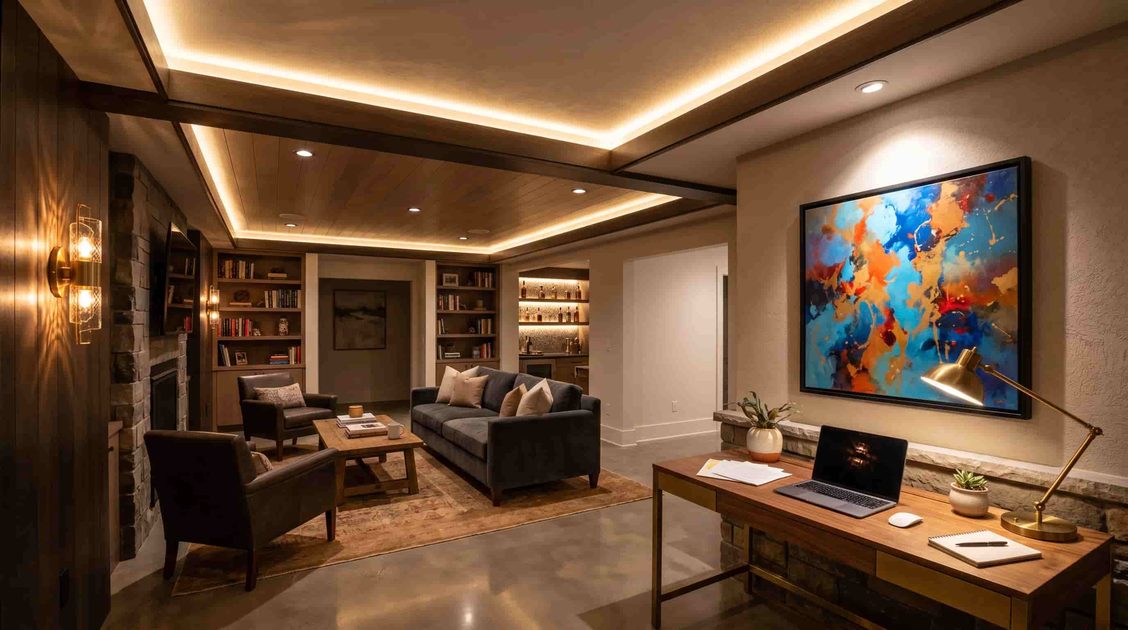
The Cove Trick
A continuous LED cove around the perimeter of the room, tucked into a soffit or a wall-mounted channel, washes the ceiling with light. This is the single most effective move in a low basement. It makes a 7-foot ceiling feel like 8 feet because the brightest plane in the room is the ceiling, not the floor. Cove lighting requires a reveal — a gap of at least 3 inches from the top of the channel to the ceiling — and a continuous LED strip rated for 3000K. I spec this in every basement media room, lounge, and guest suite. Cost is roughly $12 to $18 per linear foot installed, including the driver and dimmer.
How I Sequence
I design basement lighting in this order: cove first, then task, then accent, then ambient. The cove defines the ceiling plane. Task lights put illumination where hands work. Accent gives the room depth. Ambient fills whatever is left. Each layer on its own circuit, each on a dimmer. The result is a room that can shift from work to movie to party without anyone reaching for a breaker.



No notes yet — write the first one.