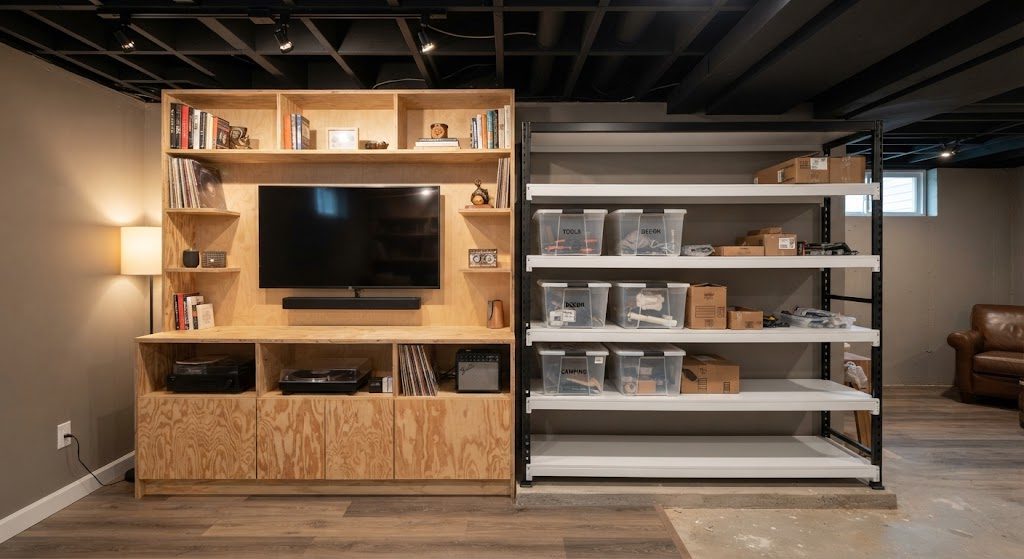
A custom cabinet built by a finish carpenter runs $500 to $1,200 per linear foot in Chicago. A stock shelving unit from a home center runs $80 to $200 and arrives in a flat box. Both hold things. The difference is fit, finish, and how long they last in a below-grade environment. I spec custom cabinetry in three specific basement locations. Everywhere else, I point clients toward stock or semi-custom options and tell them to put the savings into lighting or flooring.
Where Custom Pays Off
Built-In Media Units
A basement media wall typically spans 8 to 14 feet and needs to house a TV or projector screen, AV components, gaming consoles, and often a soundbar or in-wall speakers. Stock shelving units don't align with screen proportions, don't manage cable routing, and don't anchor a room visually. A custom media unit does all three. The unit gets a ventilated compartment for components with grommeted cable pass-throughs, open shelving at the sides for media storage, and a recessed cavity for the screen with a 2-inch reveal on all sides for airflow. Build it in plywood with a painted or veneer finish. Budget $3,000 to $6,000 for a typical 10-foot unit. This is the one place where custom earns its cost every day.
Wet Bar Cabinetry in High-End Basements
If the basement bar is the primary entertaining space and the house above has a custom kitchen, the bar cabinetry should match the quality level. A bar with an ice maker, beverage fridge, and sink needs cabinet boxes that can handle moisture and weight. I spec plywood boxes with solid wood faces, finished to match the house's kitchen millwork. The bar becomes an extension of the home's design language rather than a downgrade. Budget $4,000 to $8,000 for an L-shaped bar with uppers and lowers. If the basement is a casual media room with a basic dry bar, skip custom — stock cabinets with painted doors work fine.
Under-Stair Storage
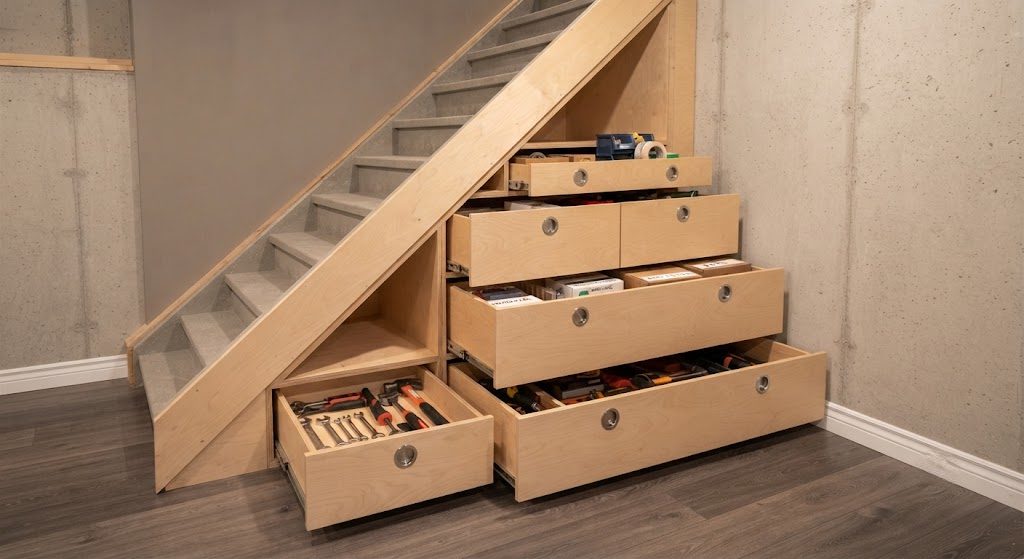
The triangular void under the basement stair is an awkward shape that stock shelving cannot address. Custom pull-out drawers or a concealed door with shelving inside turns dead space into storage for shoes, games, or seasonal gear. A well-built under-stair unit with three to four pull-out drawers on soft-close slides runs $1,500 to $2,500. It uses square footage that would otherwise collect dust. I covered the stair landing problem in a previous Layout post — this is the storage solution that completes that entry sequence.
Where Stock Shelving Is Fine
Laundry Room Storage
A basement laundry room needs open shelving for detergent and a hanging rod for air-drying. Stock metal wire shelving or laminate shelves on metal brackets do this for under $150. Moisture and humidity in a laundry room will warp plywood cabinetry over time unless it's fully sealed. Stock is easier to replace and functionally identical. I spec stock shelving for every basement laundry room.
General Storage and Utility Areas
Basement storage rooms, mechanical closets, and workshop corners don't need custom joinery. Heavy-duty plastic shelving units or powder-coated steel racks hold totes, tools, and seasonal decorations at $60 to $120 per unit. They're adjustable, they don't absorb moisture, and they can be reconfigured when storage needs change. I've seen clients spend $2,000 on custom storage cabinets in a utility room that would have been better served by $300 in steel shelving and a solid workbench.
Kids' Zones
The Wicker Park playroom we covered used a low plywood storage unit as a room divider, and that unit was custom because it served a spatial function. But the bins, cubbies, and toy shelving within the kids' zone were stock. Children's storage needs change every two years. Stock components can be swapped, reconfigured, or replaced without guilt. Custom built-ins in a kids' zone are a donation to the next homeowner's demolition crew.
The Rule
Custom cabinetry is worth the cost when it solves a spatial problem — fitting an awkward dimension, integrating with architecture, or matching an existing design language. Stock shelving is the answer when the job is simply holding things. If a shelf doesn't need to align with a screen, match a counter, or fit into a triangle, buy it in a box.


No notes yet — write the first one.