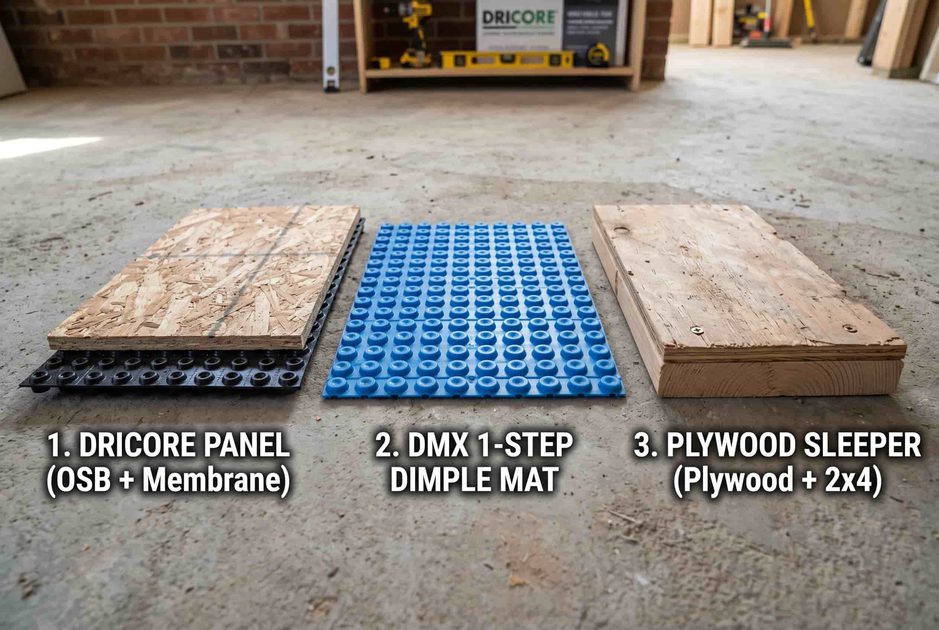
The concrete slab looks flat. It's not. The basement smells dry. It might not stay that way. The subfloor you put between the slab and your finished floor has one job: manage moisture and create a surface that feels like a real room. Three systems dominate the Chicago market. Each has a specific use case. I've used all three, and I've torn out two of them when they were installed in the wrong conditions.
Three Subfloor Systems
Dricore
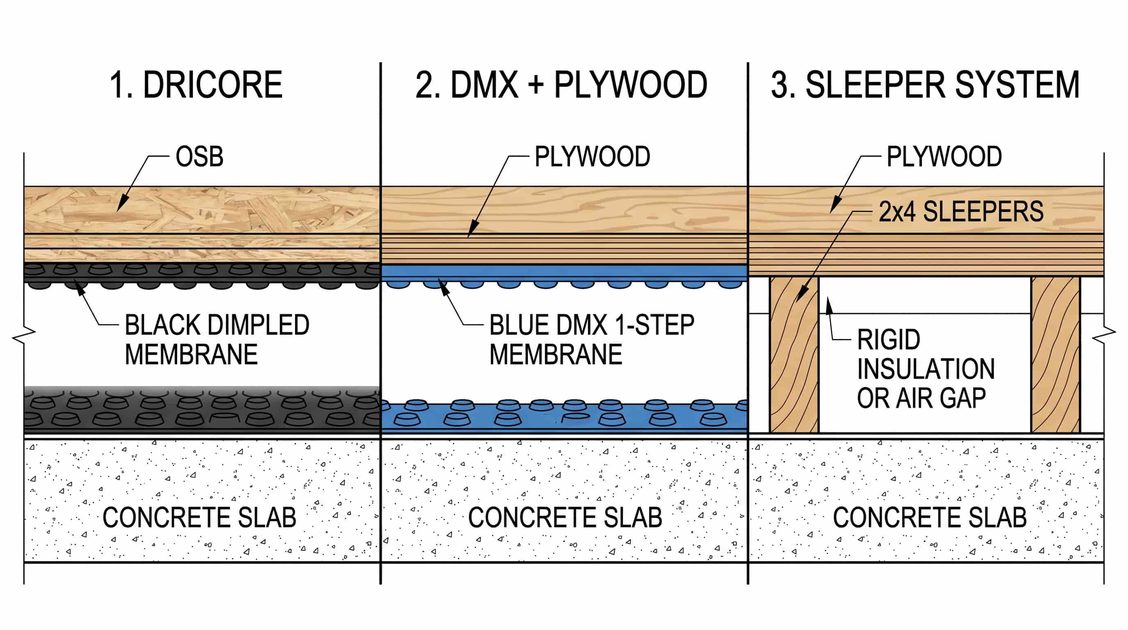
Dricore is a 2-by-2-foot floating panel — OSB on top, dimpled plastic on the bottom. The dimples create an air gap that lets the slab breathe and moisture evaporate. Panels click together with tongue-and-groove edges. No adhesives. No fasteners into the concrete. I spec Dricore when the slab is reasonably flat and the basement is dry but not perfectly climate-controlled. It raises the floor by about 1 inch, including the panel thickness. It works under carpet, engineered hardwood, and luxury vinyl plank. It does not work under tile — too much deflection. Cost runs $1.80 to $2.50 per square foot for materials. A homeowner with a circular saw can install it in a weekend.
DMX 1-Step with Plywood
DMX is a dimpled membrane roll — no OSB attached. You roll it out over the slab, tape the seams, and float 5/8-inch or 3/4-inch tongue-and-groove plywood on top. The plywood gets screwed to itself but not into the concrete. The plastic dimples create a drainage cavity that channels any moisture toward a floor drain or sump. I spec DMX when there is occasional seepage risk — older Chicago foundations, clay soil, cracks that have been sealed but aren't guaranteed. The cavity handles water that Dricore's OSB would absorb. Material cost is lower — about $1.20 to $1.60 per square foot — but labor is higher because you're handling two layers. Total height adds 1 to 1.25 inches. This system accepts any finished floor, including tile with an uncoupling membrane on top of the plywood.
Plywood Sleepers
Sleepers are pressure-treated 2x4s laid flat on the slab in a grid, with rigid foam insulation between them, and 3/4-inch plywood screwed on top. This is the system I spec when the slab is dramatically unlevel — more than 1/2 inch over 10 feet — because you can shim each sleeper to create a perfectly flat plane. It also lets you run electrical conduits and plumbing supply lines under the floor. The downside: it eats 1.5 to 2.5 inches of headroom, depending on shimming. In a 7-foot basement, that matters. I use sleepers for basement ADUs and guest suites where a dead-flat floor and thermal break are worth the height penalty. Cost is higher — $3.50 to $5 per square foot with insulation and labor.
How I Choose
Step One: Tape Test
I tape a 2-by-2-foot square of clear plastic to the slab for 48 hours. If condensation forms underneath, there's moisture migrating through the slab. That eliminates Dricore unless the source gets fixed. I cover this test in more detail in the air quality post.
Step Two: Level Check
A laser level and a straightedge tell me how much variation I'm dealing with. Under 1/4 inch over 10 feet: Dricore or DMX. Over 1/2 inch: sleepers. Between those numbers depends on finished floor tolerance.
Step Three: Finished Floor
Luxury vinyl plank can float over any of these systems. Carpet wants Dricore or sleepers. Tile wants DMX with plywood and a membrane, or sleepers with a cement board layer. I never bond tile directly to the slab in a Chicago basement — too much thermal movement. The numbers post on basement costs breaks down what each assembly runs per square foot, installed.
My Default
For dry basements with 7 feet 6 inches or more of headroom and a planned LVP or carpet floor, Dricore is the simplest answer. For anything with a hint of moisture history or a tile floor, DMX with plywood wins. Sleepers are the heavy-duty option — reserved for apartment-grade finishes and slabs that look like a topographical map.



No notes yet — write the first one.